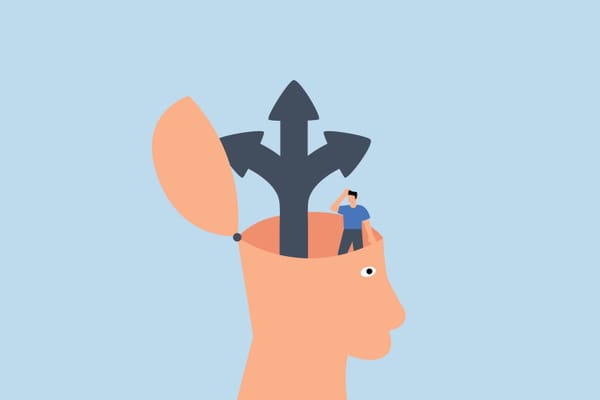
Stop Believing Your Own Lies: A No-Nonsense Guide to Crushing Limiting Beliefs
Limiting beliefs keep you stuck. Learn the 5-step process to identify and crush the mental lies that are holding you back.

Your Brain Is a Liar: How Limiting Beliefs Keep You Stuck (and How to Break Free)
Imagine for a moment you believe you can land that promotion at work. Or you believe you can become a hobbyist painter. Or you believe you can start your own business.
Now, what if I told you the only thing standing in the way of you doing any of that is your own brain?
It's true. Your brain is holding you back.
What you're dealing with is limiting beliefs. And they're running your life whether you realize it or not.
What Limiting Beliefs Actually Are
Limiting beliefs are the stories your brain tells you about who you are and what you're capable of.
They're assumptions that feel like facts. They sound authoritative and final, like they're based on some objective truth.
But they're not facts, they're opinions. Old opinions, usually. Opinions you formed years ago, often in childhood, based on incomplete information and experiences you may not even remember.
These beliefs act like a jail cell. They keep you locked up in the same place, the same mindset, and the same life. They scream at you: "You're not good enough!" "You could never do that!" "You don't deserve that!"
And they continue to scream until you actually start believing them.
But here's the thing you need to understand: It's all lies.
Where Limiting Beliefs Come From
You weren't born believing you couldn't do things. Nobody comes into this world thinking "I'm not smart enough" or "I don't deserve success." Those beliefs were installed later.
Some came from your parents, who probably didn't know any better. They passed on their own limiting beliefs without realizing it. "Money doesn't grow on trees." "People like us don't do that." "Don't get your hopes up."
Some came from teachers, coaches, or other authority figures who made offhand comments that stuck with you for decades. That one time someone said you weren't good at math? It became a permanent identity.
Some came from your own experiences. You tried something, it didn't work, and you decided that meant you couldn't do it. Ever. Case closed.
And some came from society at large. Messages about what's possible for people of your age, gender, background, education level, or whatever other category you've been slotted into.
The problem is none of these sources had complete information. None of them could predict your future. And none of them knew what you'd be capable of with effort, practice, and the right mindset.
How Limiting Beliefs Keep You Stuck
Limiting beliefs don't just sit passively in your head. They actively shape your behavior in ways you might not even notice.
They filter what you see. Your brain looks for evidence that confirms what you already believe. If you believe you're bad with money, you'll notice every financial mistake you make while ignoring every good decision. Psychologists call this confirmation bias. Your limiting beliefs use it against you constantly.
They dictate what you attempt. You don't even try things you've already decided you can't do. Why would you? If you "know" you're not creative, you won't sign up for that art class. If you "know" you're not leadership material, you won't apply for that management position. Your limiting beliefs close doors before you ever reach them.
They sabotage your efforts. Even when you do try something that bumps up against a limiting belief, you often sabotage yourself. You don't prepare as well as you could. You give up at the first sign of difficulty. You look for reasons why it won't work instead of ways to make it work. And then, when it doesn't work out, you point to that as evidence that your limiting belief was right all along.
They become self-fulfilling prophecies. The belief creates the behavior. The behavior creates the outcome. The outcome reinforces the belief. It's a vicious cycle that can run for decades without you ever questioning it.
The Proof That Limiting Beliefs Are Lies
Here's something I want you to think about for a moment.
Everything you can do today, whether it's cooking dinner, driving a car, or leading a team, was once something you'd never done before. At some point, you had to do it for the first time. You were a complete beginner. You probably sucked at it.
But you figured it out, right? And you're probably pretty damn good at some of those things now.
So why would that pattern suddenly stop applying to whatever you're telling yourself you can't do next?
The only difference between the skills you have and the skills you think you can't learn is time and practice. That's it. The capability isn't missing. Your brain just convinced you to stop trying.
Think about a five-year-old learning to ride a bike. They fall down constantly. They're terrible at it. By any objective measure, they "can't" ride a bike. But nobody says "Well, I guess this kid just isn't a bike-riding person." We understand that learning takes time and falls are part of the process.
Somewhere along the way, you stopped applying that same logic to yourself.
The 5 Types of Limiting Beliefs Holding You Back
Limiting beliefs show up in predictable patterns. Here are the most common ones I see:
Type #1: Identity beliefs.
These are beliefs about who you are as a person.
- "I'm not a creative person."
- "I'm not good with people."
- "I'm just not the type who succeeds."
These are the most damaging because they make the limitation part of your identity. You're not just bad at something; you ARE someone who is bad at it.
Type #2: Capability beliefs.
These are beliefs about what you can or can't do.
- "I can't learn new technology."
- "I could never speak in public."
- "I'm not smart enough for that."
Type #3: Worthiness beliefs.
These are beliefs about what you deserve.
- "I don't deserve to be happy."
- "Good things don't happen to people like me."
- "I'm not worthy of success."
Type #4: Possibility beliefs.
These are beliefs about what's possible in general.
- "It's too late for me to change."
- "The economy won't let me succeed."
- "All the good opportunities are taken."
Type #5: Permission beliefs.
These are beliefs about what you're allowed to do.
- "I shouldn't want more than I have."
- "It's selfish to focus on myself."
- "I need someone's approval before I can try."
Most people have beliefs in multiple categories, often reinforcing each other.
Your 5-Step Action Plan to Crush Limiting Beliefs
If you want to break free from limiting beliefs, here's a practical process you can start using today.